Healthcare Vendors & Supply Chain Leaders: Challenges and Opportunities in the Quest for a True Strategic Partnership
By DAVID STONE
PARTNER
Congratulations, you’ve won the GPO contract. The most challenging part of establishing a partnership is now behind you, right? Well, maybe not. In fact, winning a contract is just the first major hurdle to clear. The next [and it’s a biggie] is successfully activating that contract so that it’s productive and sustainable through stakeholder engagement, implementation support, and sustained pull-through.
This is just one thing we learned in a recent LinkedIn survey conducted in advance of the 2026 ANAE National Accounts Summit held in Atlanta in late-July. I conducted the 8-question survey to support a workshop I was moderating entitled From Vendor to Strategic Partner: What Supply Chain Leaders Expect from Suppliers.
Survey results were quite interesting and reveal current challenges – and identify opportunities for improvement – in the quest to develop and maintain a true strategic partnership between healthcare suppliers and supply chain leaders. Some findings, no doubt you know from first-hand experience while others may surprise you.
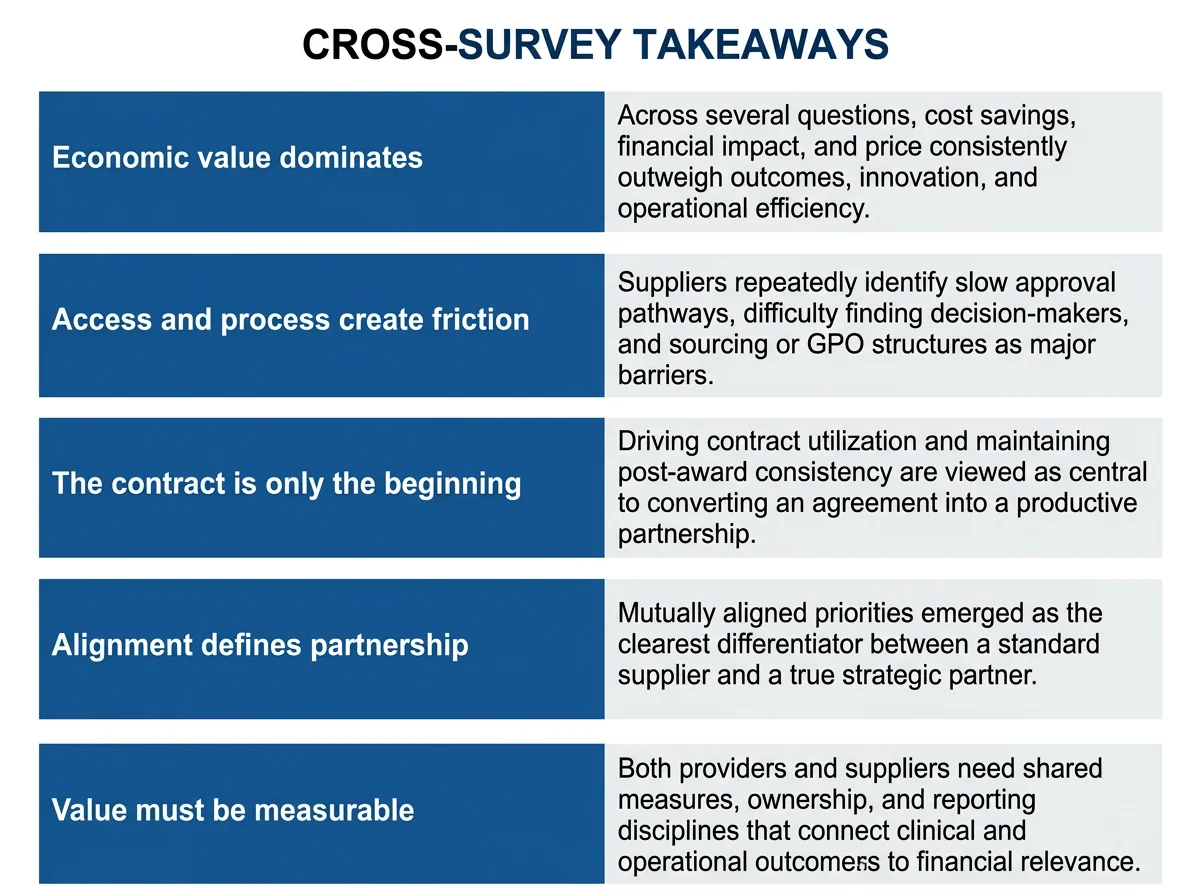
Let’s begin by looking at the five Cross-Survey Takeaways we mined from the results and then we’ll get more specifically into the numerics for each question. For detailed survey results, click here.
Survey Questions
1. In your experience, where is the biggest gap between what providers say they value vs. what actually drives decisions?
Responses point overwhelmingly to an economic disconnect. Cost reduction and price account for approximately 75% of votes, suggesting that outcomes, innovation, and partnership may be valued conceptually but often lose influence when a final decision is made. The key question is whether provider incentives still favor near-term savings, or whether suppliers are failing to translate broader value into measurable financial and operational relevance.
2. Which supply chain challenge limits your ability to deliver value?
Principal barriers are structural rather than product-related. Slow approval processes and limited access to decision stakeholders dominate results, indicating that suppliers may have a credible Value Proposition but struggle to move it through the organization or present it to the people best positioned to evaluate it.
3. Where do suppliers lose the most momentum when working through GPO and IDN contracting structures?
The contract award itself is not viewed as the greatest obstacle. Half of respondents identify contract utilization as the point where momentum is most often lost, while another 35% cite finding the right decision-makers. This reinforces the distinction between winning a contract and successfully activating it through stakeholder engagement, implementation support, and sustained pull-through.
4. What does a true strategic partner do differently from a standard supplier?
Strategic partnership is defined first by alignment and then by execution. More than half of respondents selected mutually aligned priorities, while more than one-quarter emphasized consistency after the contract is signed. The 0% response for cross-department engagement may indicate that broad access is viewed as a means to partnership rather than the defining characteristic of it.
5. Suppliers, in your experience, what do providers understand least about working with suppliers?
An overwhelming 90% of responses center on value measurement and commercial sustainability. Suppliers appear to believe that providers may underestimate both the difficulty of tracking value over time and the economics required to support service, implementation, inventory, innovation, and account management. Silver Lining: This indicates an opportunity for both sides to define success measures and economic expectations earlier in the relationship.
6. Which of these issues most limits your ability to demonstrate value to provider supply chain teams?
A solid 80% of respondents identify process complexity and stakeholder access as the dominant barriers. This suggests that suppliers may not lack a value story, they may lack a clear pathway to present it to the appropriate clinical, operational, financial, and supply chain audiences, influencers and decision-makers. The challenge for providers is to preserve disciplined sourcing processes while enabling credible solutions to receive appropriate review.
7. We talk a lot about “value” in healthcare, but what actually drives decisions?
It may not be entirely “all about the money” but is “mostly about the money”. Financial impact clearly dominates the decision hierarchy. The 0% response for operational efficiency is especially notable because health systems frequently emphasize labor productivity, workflow improvement, and throughput. One possible interpretation is that operational benefits are not ignored, but are harder to quantify, validate, or defend internally than direct savings.
8. What is the biggest barrier to gaining access to health system supply chain?
Barriers to access are clearly multi-dimensional. Results indicate access depends on more than finding the right point-of-contact. Formal sourcing and GPO requirements are the largest single barrier, followed closely by identifying the correct decision-makers. Effective access therefore requires preparation, relevance, knowledge of the health system’s unique priorities, and respect for its rules of engagement.
To see the detailed survey results, click here.
ABOUT DAVID STONE
David has a proven, multi-disciplined background in sales, sales management, national accounts and national accounts team management. His areas of expertise include clinical laboratory diagnostics, remote patient monitoring, surgical device, advanced wound care, medical disposables and clinical nutrition.
David has spent more than three decades creating and cultivating key relationships within the U.S. healthcare industry, including Group Purchasing Organizations, Integrated Delivery Networks and Regional Purchasing Coalitions. He facilitates executive-level introductions and provides assistance with sales strategy, strategic account segmentation, field sales optimization, offer development and contract negotiations.
Most recently, David has worked at Coloplast, Mölnlycke and Medtronic. His primary focus will be to use his wide-ranging background to help Excelerant clients experience meaningful growth and margin enhancement.
ABOUT EXCELERANT CONSULTING
Excelerant Consulting is the go-to organization for med-tech companies that need to position products and services successfully for Value Analysis Committees [VAC], contract acquisition, and sales modeling and execution to commercialize the launch of medical devices or services with Group Purchasing Organizations [GPO], Integrated Delivery Networks [IDN], or Regional Purchasing Coalitions [RPC]. Our clients rely on us to identify their value proposition, enhance product positioning, navigate corporate contracting opportunities, and provide sales support to accelerate growth.
For more info, contact Excelerant Consulting at info@excelerantconsulting.com